How to Teach Geometry Concepts Using the Colossal Poster Basic Geometry?
- Jack Wrytr
- Dec 24, 2025
- 4 min read
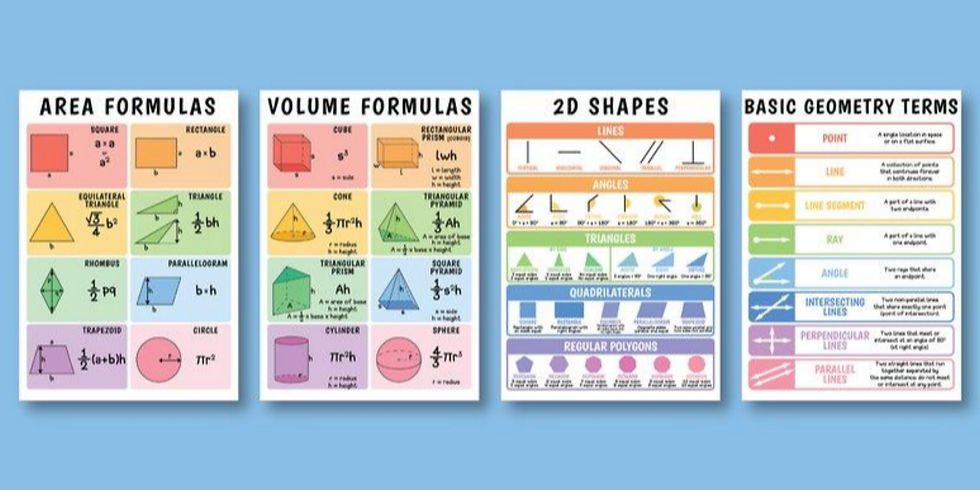
Geometry is complex for a lot of students. They have difficulty picturing the plane and understanding how different angles work together. Most children simply memorize the terms used in geometry without fully understanding the underlying concepts. Teachers seek instruments that make invisible concepts clear. Throughout this guide, practical methods for using classroom posters to teach stick-and-learn geometry concepts are presented.
Reasons Why Geometry Teaching Is Usually Considered Difficult
Points, planes, and angles are all availed in space. They are not physically tangible to the students. The ideas remain vague if there is no visual support. A student who might read the word "perpendicular" ten times won’t get the meaning unless they can visualize it. Typically, when students fail to grasp basic geometry concepts, their understanding of more advanced concepts is adversely affected.
Most of the time, such students lose their confidence. The primary reason for this situation is not that the student is incapable of learning, but that they have not been provided with a strong visual foundation on which to build.
These problems point out the importance of visual education in the teaching of geometry.
The necessity of the visual learning method in geometry
Learners don’t forget what they frequently see. A visual present in their classroom every day is integrated into their learning process. They look at it during the lectures. The information becomes stuck due to this continuous exposure. Each and every visual learner requires a clear view of the concept. A geometry poster will serve all the students. It will supplement the spoken explanations and provide a common reference point for all the students in the class.
Using a Geometry Poster as a Core Teaching Tool
The Colossal Poster Basic Geometry works as more than a wall decoration. Throughout the year, teachers consider it a shared visual aid. The poster features a wide range of geometrical terms, figures, and relationships all at once. Students can easily access and understand the difference between acute and obtuse angles at any time. The poster is visible at all times and is always ready when students need it.
In the case of teachers pointing to the poster during lectures, students can see the term and the visual presented together. This sensory-based vocabulary empowerment is a major contributing factor in students' eventual ability to use these words in the appropriate context. The poster's effectiveness, whether as a tool or as background decoration, depends entirely on how teachers choose to use it.
Practical Ways to Integrate Geometry Posters into Daily Lessons
Teachers can incorporate poster references into their activities in each lesson.
Warm up the class with a quick question that refers to a shape on the poster
Take a break in the middle of the lesson to show the visual when explaining new ideas
Conclude with a question to the students that they have to give something from the poster
Familiarity grows with frequent dealings. The pupils are aware of the place to search. They will look up the poster without even realizing it as soon as they encounter a problem.
Repeated interaction builds both confidence and mastery over time. This approach answers a common teacher question about how to make math fun and engaging for all grade levels.
Encouraging Student Interaction and Concept Mastery
Participation is a potent factor in students' learning. For example, teachers may have students identify different shapes on the poster. Discussions among peers are more fruitful if everyone can see the same image. After a few weeks of constant pointing out, students begin to do it on their own. They depend less on memory and more on comprehension. This movement indicates a significant advancement in learning.
Standardized tools enable this method for overworked trainers.
Choosing Reliable Instructional Resources
Not every classroom poster is equally effective. Some posters lose their colors fast. Others are difficult to read. Teachers want materials that can be used for several years. Simple and long-lasting tools lessen everyday annoyances.
This raises the question of how much trusted educational suppliers contribute.
Strengthening Teachers' Work with Custom-Made Tools
Geyer Instructional Products has partnered with teachers since 1960. The company originated when a mathematics teacher developed the necessary materials for his teaching. The educator-oriented philosophy is still valid today. Their geometry posters show what teachers actually need, not merely what looks good in a catalog.
Bringing Geometry Concepts to Life
Visual-first instruction is a transformative method that supports students in learning abstract mathematics. Rather than devoting all their efforts to memorization, they develop a deep understanding of the topic. A simple poster becomes a teaching partner that works all year. Teachers looking to strengthen geometry instruction can find classroom-ready materials from Geyer Instructional Products that help students truly understand what they're learning.
Frequently asked questions about the use of visual tools in teaching geometry.
Why are visuals considered to be the main factor in making geometry easier to learn?
Visuals enable students to relate abstract terminology to concrete objects through images. The idea becomes more accessible to memory and usage.
What is the recommended frequency for geometry posters’ reference?
The reference to posters should be made daily. Quick references solidify learning without taking up additional time for lessons.
Are posters still useful for elderly students?
Definitely, visual aids are effective for high school students in test preparation as well as in dealing with challenging proofs in Geometry.
Comments