Interior Design Living Room with Plants: Modern Biophilic Ideas for Stylish, Healthy Homes
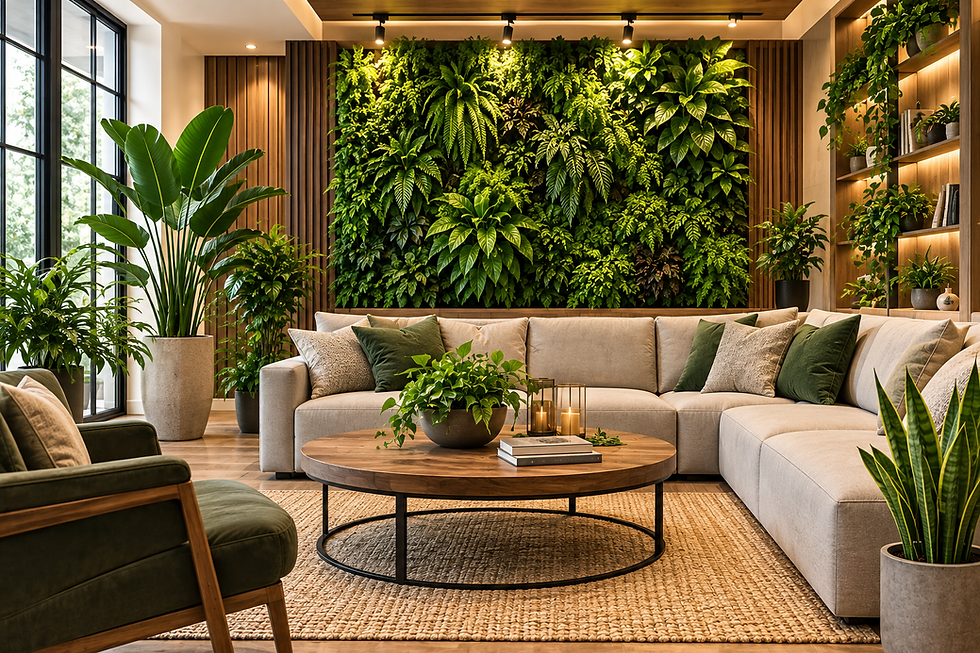
After a long workday, imagine coming home to find your living room feels really stuffy. The air seems stagnant, the furniture has no shape, and you're not really sure what you want to look at next in the room. What a great idea, though, that you could have the feeling of a space where you breathe and live without having jungle-type, heavy-maintenance plants covering every floor of the house!
In this guide you'll discover how to combine living walls with the principles of biophilic design to convert your living room into a modern healthy retreat. The article covers not only the definition of living walls but how they differ from traditional plant decorations, the features that make them function properly. Moreover, you will be given step-by-step assistance from planning the project, installation, through regular cleaning up your living wall.
What Makes an Indoor Living Wall
Indoor Living Wall, or commonly a Green Wall Installation or Living Wall Installation, is the term used to describe a system of plants growing in an upright position supported by a structure attached on an indoor wall.
The system is generally an array consisting of panels or modules fixed between an upright frame, which serves as the plant growth medium an alternative to soil. The plant is inserted in a pocket, a tray or a felt mat. Water and nutrients supplied by an irrigation network starting from the top or a storage tank are absorbed by the plants. What is not absorbed goes into the collection drain. When the available light is not enough, additional grow lights are used. Since such system can be either hydroponic or substrate-supported, the roots are vertically supported while the air flows around the leaves and other plant parts. This is the main reason why Commercial Living Walls Installation is different from just having plants potted and placed on shelves.
For more detailed info, check out Commercial Living Walls Installation: Enhancing Offices, Retail Spaces & Hospitality Environments
Indoor Living Walls vs. Potted Plant Arrangements
Feature/Factor | Indoor Living Walls | Traditional Potted Plants |
Space Use | Vertical, frees floor and table space | Horizontal, requires shelves or floor area |
Visual Impact | Creates a single architectural focal point | Distributed, looks collected over time |
Maintenance | Centralized irrigation, scheduled pruning | Water each pot individually |
Air Quality Effect | Larger leaf surface in one zone boosts humidity | Impact depends on plant quantity and placement |
Install Complexity | Needs structural support, plumbing, lighting | Place and go, minimal setup |
What Makes Living Walls Perform: Design Tips for Function, Not Just Looks
Light is essential: plants get their food energy from sunlight via photosynthesis. Without the necessary foot-candles, even the shade-loving varieties will stretch and die. Make sure that when you pick out a plant, you're thinking about the actual light levels measured, not just which way the window is facing.
Air flow is essential to prevent issues: plants' leaves can't dry quickly so dense foliage can retain moisture very easily. When air is stagnant, the wall substrates mildews. Make sure there are clearances of 6-12 inches from the vents of your HVAC system. You can install a small circulating fan connected to a timer so that it can be a natural breeze for a few minutes at a time.
The main factors for building structure are weight and water: A wall completely saturated with living flora has a potential weight range of 10, 15 lbs per square foot. Because of that, your framing and supports need to be strong enough to bear that weight. Besides being aesthetic, Living Wall Installations in Columbus also need to be a bit of functional work so the client gets the quote right after you have made an on-site evaluation.
To manage maintenance, your choice of plant varieties matters a lot: It is very appealing having one plant but if the disease gets in, you will lose your entire wall. Plantings of different types having similar water requirements help create a more balanced ecosystem which is more resilient. Low-light interiors can be made to look tropical and green by using pothos, philodendrons, and ferns that are very forgiving in their leaf humidity requirements.
Physical access to care should be considered in planning: In most cases, people won't prune the uppermost row of a wall, because it requires the use of a ladder. Therefore, create service access areas, or simply avoid tall walls for private premises. They should be below 8 ft.
Choosing the Right Options: Residential Living Room vs. Commercial Lobby
Factor | Residential Living Room | Commercial Lobby Installation |
Primary Goal | Wellness, personal aesthetic | Brand impact, dwell time, air quality for traffic |
Scale | 10–40 sq ft accent wall | 50–300+ sq ft feature wall |
Irrigation | Manual tank or plumbed with shutoff | Automated, plumbed, with leak sensors |
Maintenance | Monthly by homeowner or service plan | Weekly/biweekly contracted service |
Budget Driver | Material finish and plant type | Structural work, MEP coordination, longevity |
How to Plan a Cohesive Interior Design Living Room with Plants
1. Evaluate the wall's lighting and space first: At various times of the day, 9AM, 12PM, and 4PM you can record light meter or simply the light intensity of any mobile app. Also, HVAC units need to be kept in close proximity, so you should make note of the positions if the wall is going to be placed near them. This step is especially important when planning an interior design living room with plants to ensure healthy plant growth.
2. Determine the wall's role: Is it to be a wall with soft acoustics, a wall dividing two spaces, to enhance the air indoors or to create an ideal backdrop for taking pictures? Once the function is decided, it influences the planting density, the planting type, as well as the type of living wall system.
3. Pick a suitable system, modular panels are the best choice for a retrofit DIY project: Light felt pocket systems are the ideal for very light weight. Hydroponic tray units have been found suitable for those larger commercial living wall installation jobs that require automation systems.
4. Choose your plant types based on light requirements, low light: pothos, ZZ, ferns. Bright indirect light: anthurium, calathea, peperomia.
5. Don't plant high water and succulent types in the same area.
6. Finish materials should be in line: The wall frame, the trim that runs along the edge, and the surrounding paint or the decorative wood should have a deliberate look. Think of the wall as your room furniture that blends the environment, not as a decoration you hung on it.
7. Even a unit that is described as self-sufficient still requires an outlet with a Ground Fault Circuit Interrupters (GFCI) and a water tank refilling plan.
Production and Ordering Logistics
The lead times, minimum orders, and other rules of the game differ with each fabricator; it's best to confirm with the one that you've chosen.
Lead time: The period required from design conception stage till complete product realization is usually 4, 8 weeks post site measurement approval by client side and MEA drawing submission/confirmation by fabricator side.
Project minimum: Many commercial installation teams have a lower bound at 20 sq ft as the cost of setting up shop will still fall on them. The home market might get away with something less if you are ordering off-the-shelf products.
Revisions: If there are changes in the plant material, these will be accommodated as long you don't get too close to installation time, say 7 days at most. Any major change to the structure after a set of drawings have been prepared by the shop will be billed separately via change orders.
Rush policies: Your installation order, if it happens to be a rush one, would probably be processed for you only if there is a plant stock and a crew available, and this may involve a surcharge. On rush projects, availability of different kinds of plants is going to be very limited.
Get your chosen fabricator to confirm all the details you agreed with. If you go on the assumption about a price or a timeline without a signed proposal, it can lead to unpleasant surprises.
Care and Maintenance for Indoor Living Walls
Watering: Make sure to check the water level in the reservoir weekly. Most automated watering systems run for 1, 3 minutes daily with possible seasonal adjustments.
Pruning: To keep the plant wall compact, remove any yellowing leaves and trim back the overly tall growth every month.
Fertilizer: Dilute a balanced liquid fertilizer to ¼ of the recommended strength and add to the irrigation tank every 4, 6 weeks.
Maintenance: Every quarter or so, clean the edges off the frame and also check the emitters for blockages.
Pest management: Regularly look after the plants for fungus gnats or spider mites. Once an infestation has been detected, the best practice is to isolate the affected area and use horticultural soap for treatment.
FAQ
What is the best system for a living room with low natural light?
A panel system with integrated LEDs that are full-spectrum is the best choice when there are low levels of natural light. Plants like pothos, philodendron, and aglaonema are recommended because they are able to survive with 50-100 foot-candles of artificial light.
How long does one Green Wall installation take?
Pipe and physical installation usually on site takes 1-3 days after the fabrication period. From time to final contract to time of completion of the project it is normally 8 weeks if not 12 weeks for the complicated one and the other one which has been affected with MEP work.
What’s the minimum size for Living Wall Installations in Columbus or similar markets?Many professional installers have a 20–40 sq ft minimum for custom plumbed walls. Smaller pre-built units under 20 sq ft are available for residential use without a minimum.
Can we personalize the plant selection or frame finish?Yes. Most vendors let you choose from a plant list suited to your light level and select frame materials like wood, powder-coated metal, or laminate. Custom colors may extend lead time.
How do we care for it if we travel often?Specify an automated irrigation system with a reservoir sized for 2–4 weeks of water, plus remote leak monitoring. For residential, a service plan for monthly check-ins prevents issues while you’re away.


Comments