The Amazing Process Behind Cremation Diamond Jewelry From Ashes
A diamond of just one carat is the fruit of a billion year old natural process under earth's immense pressure of 100 miles. But nowadays a lab can convert cremated remains into a gem like diamonds in a few months. The difference between a billion years versus a few months is the very narrative that turns grief into a science.
When you wonder how those few scoops of ashes can become a piece of jewelry you can wear, you will definitely find yourself reflected by our research. Cremation diamond jewelry is not a new thing and in fact interest in such type of memorials has been increasing quite steadily over the past ten years especially those families who are seeking some kind of memorial that isn't just something you keep on your shelf, it would be something you can have close to you and with you. This article will show you step by step what is actually happening, what can be trusted by science, and what questions should be asked before one makes a commitment.
What Cremation Diamond Jewelry (Memorial Diamond Jewelry) Actually Is
Diamonds made of human remains or ashes are the result of a unique lab-grown process, using carbon derived from ashes. The names 'cremation diamonds' and 'memorial diamonds' are also used. Ash diamonds, as they are sometimes called, are essentially identical to natural diamonds in their composition. They have the same crystal structure, hardness properties, and color refractive abilities.
The one distinguishing factor is actually the source of the material, not its chemical or physical properties. A skilled gemologist using standard equipment would not find any distinguishing features between the memorial diamond and the mined diamond as the chemical nature of the two is the same down to the atomic level.
Creatable from carbon isolated in cremated remains or hair
Laboratory-grown via high-pressure, high-temperature (HPHT) or chemical vapor deposition (CVD) methods
Quality, clarity, and color are tested in the same way as a diamond from any other source
There is a vast selection of cuts, colors, and carat weights depending largely on carbon content available
Step One: Extracting Carbon From Ashes for Diamond Ashes Jewelry
Creature remains consist of mostly calcium phosphate and not carbon. Carbon makes up most of the body but is mostly burned off during the cremation which burns at around 1, 400, 1, 800°F.
The main element that people are usually caught by surprise about is the fact that what's left consists basically of a minimal quantity of carbon that typically constitutes 1, 5% of the total ash weight, but it also greatly depends on the individual and the cremation practices at different places. Labs, in turn, employ a chemical method to purify this carbon and transform it into graphite before it is suitable for any use, though!
Carbon Yield Differences in Ash
Everything from diet, age, and the density of the bones up to the type of cremation machines used can actually determine the level of usable carbon that the ashes will contain. This explains why trustworthy laboratories ask for a smallest sample amount of ashes (e.g., 200 grams) rather than giving a definite promise about the results.
Step Two: Growing the Cremation Diamond
After graphite has been isolated, it is placed into a diamond-growing chamber. The two methods most commonly known are:
HPHP (High Pressure, High Temperature).
This means replicating the natural conditions under which diamonds are formed inside the earth's surface by using extreme pressure and heat which, together, force the carbon atoms to form a crystal lattice structure.
CVD (Chemical Vapor Deposition:
Breaking a carbon-laden gas so that the carbon atoms deposit layer by layer a tiny diamond seed that gradually grows in the chamber.
Both of these manufacturing methods are part of a wider sector producing laboratory-made diamonds. The Gemological Institute of America (GIA) has been grading and certifying these diamonds since using a set of standards (The 4Cs) that are applied for natural diamonds.
Actually, the forming period is the one which takes the most amount of time. The duration required depends on clarity and the desired size of the diamond. A diamond can therefore be anywhere between a number of weeks to two or three months in full growth.
Color a Reality Check
Pure carbon only yields a colorless diamond. A lot of the cremation diamond manufacturers are known to introduce small amounts of either boron or nitrogen under the control during the diamond's growth process, so that you get blue or yellow shades respectively and this is purely a question of how the product is being designed not the nature of the ashes themselves. That being the case, if a company asserts that the sole reason for a color being the case is simply because of the ashes used then that claim deserves being scrutinized twice; generally chemistry behind a process would not support such claims unless it is done on a colorless basis.
Step Three: Cutting and Setting the Memorial Diamond Jewelry
After the diamond takes its shape, it goes through the same process as a regular diamond getting the rough shape, cut, and polished and finally getting it set into a piece of jewelry such as a ring, pendant, or a bracelet. This is when the artist's eye takes over from the scientist in the creative decision-making.
The popular items are:
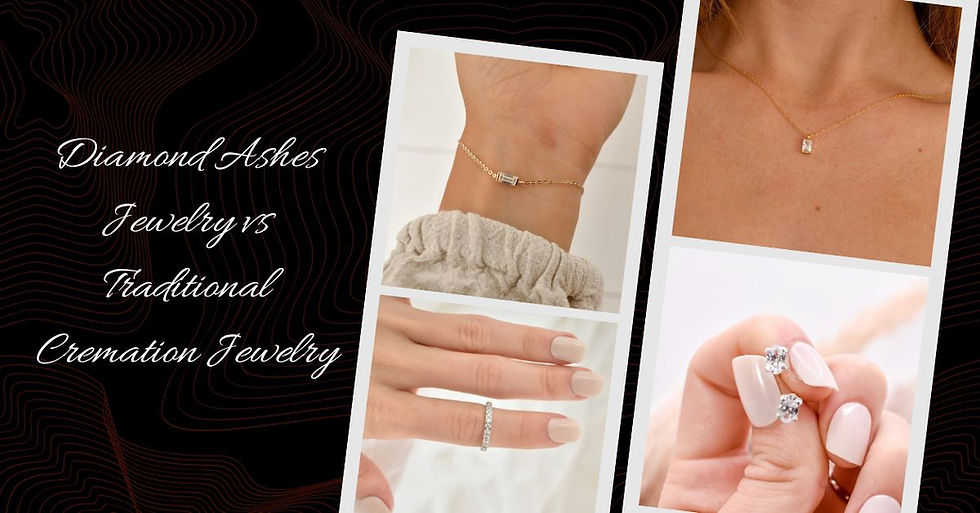
Ring is the main item which is used daily and provides physical contact through constant wearing.
Pendants and necklaces are often used for keeping the stone in view and at the same time protecting it.
Bracelets is one of the rising options for those looking for an alternative to the more formal and conventional ring.
Petals and Keepsakes offers a dedicated memorial diamond jewelry collection alongside more traditional ash-inclusion settings, for families weighing a diamond against a simpler keepsake stone.
How Long Does the Whole Process Take?
The process for making cremation diamonds usually takes about 3 to 9 months after the laboratory gets the sample up to the final, beautiful jewelry. The reason is that even after the extraction of carbon and its purification, which is a comparatively simple step, you mainly get the time it takes for the crystal growth as a large number or high clarity stones need to grow under pressure for longer periods.
Rings or jewelry made from ash that are smaller in size and do not contain a diamond take hardly any time to produce as they can be shipped quite quickly, often within 6, 8 weeks, since they do not go through the lengthy diamond growth stage at all.
Cremation Diamond vs. Ash-Inclusion Memorial Jewelry: What's the Real Difference?
This distinction trips people up more than any other part of the decision, so it's worth being direct about it.
Cremation Diamond | Ash-Inclusion Jewelry | |
What it's made of | Carbon extracted and grown into a diamond crystal | Small amount of visible ash sealed in resin or glass |
Turnaround | Several months | Several weeks |
Cost | Higher lab growth and cutting add expense | More accessible |
Appearance | Indistinguishable from a mined diamond | Ash particles often visible within the setting |
Certification | Can be independently graded (cut, clarity, carat) | Not applicable no gemological grading |
Neither option is objectively "better." A diamond suits someone who wants a permanent, gem-grade stone. Ash-inclusion pieces suit someone who wants the remains themselves visibly present, and who prefers a shorter wait and lower cost.
Practical Advice Before You Order
Before sending a sample to anywhere it is necessary to do the following:
1. You should check what happens to the ashes which are left: An honest provider should give you back any surplus material instead of just throwing it away.
2. Request a carbon-yield written explanation: A company which won't give you a reason why yield changes is definitely a company you should stay away from
3. Check the certification of the diamond: A proper memorial diamond is accompanied by official certificates and not only claims made by the company.
4. Get a warranty for the setting: Wearing prongs and a clasp can be a problem regardless of whether the stone inside is valuable or not. So you have to get warranty for the setting separately.
5. Combination options should be inquired about: There are many providers who allow ashes to be combined with different keepsakes including flowers, etc., if a diamond is not appropriate. Petals as well as Keepsakes are among them.
Diamond cultivation which requires several months or quick finishes with more simple keepsakes represent the physical form. The main principle remains identical changing a lost precious thing into an object one physically can hold for the rest of one's life.
For more detailed info, check out Complete Guide to Cremation Diamond Jewelry for Families
Frequently Asked Questions
Can a diamond be made from any quantity of ashes?
This is not a guarantee. Labs often require a certain minimum sample size since the availability of carbon for cremated ashes is so low it depends mostly on individual cremation.
If there were visible ash in the diamond would it show?
Not a bit. The process starts with isolating and purifying the carbon so any impurities are effectively removed at a chemical level. The end product has a regular crystalline structure and no traceable ash or other foreign substances are there physically. It looks identical to a pure diamond.
What about the cremation diamonds being called real by the gemological standard?
Sure. They are cultivated through HPHT or CVD processes that the entire lab-grown diamond industry follows, and hence gemological reports on them are possible.
Can one get a cremation diamond made from hair?
Laboratories vary; some will take hair instead of ashes because hair contains plenty of carbon as well. However, hair and ashes are different in terms of the amount of carbon they yield and also the details of the production process.
What color will the finished diamond be?
The default is mostly very colorless and white since naturally grown carbon doesn't have any color. However, to achieve various colorations, such as blue or yellow, trace elements are usually added deliberately during the growth. As it is the chemical addition itself, and not the ashes that determine the color, it becomes evident how such colored diamonds may still be made from one's last ashes.

Comments